
Universal Digital Wideband Air/Fuel Ratio AFR Gauge
3.8Editor score
High accuracy digital wideband tech
Standard 52mm housing fits easily
Compatible with up to 16V
Choosing the right aftermarket O2 system is crucial for any vehicle owner seeking to optimize engine performance and fuel efficiency. These systems provide real-time data on air fuel ratios, allowing for precise tuning that can significantly enhance horsepower and reduce emissions effectively.
We have carefully evaluated ten leading products based on accuracy, ease of installation, and compatibility with various engine management systems. Our analysis focuses on wideband technology, sensor quality, and display clarity to ensure you find a solution that meets your specific tuning needs reliably.
Each pick in this list highlights distinct features ranging from budget-friendly options to premium kits with advanced logging capabilities. Please note that prices and availability can change frequently, so verifying current details before purchasing is always recommended for the best experience.
3.8Editor score

4.2Editor score

4.5Editor score
As an Amazon Associate we earn from qualifying purchases.
This side-by-side comparison highlights the key specifications and features of the top ten aftermarket O2 systems available today, helping you make an informed decision based on your vehicle's specific requirements and your tuning goals.


The Universal Digital Wideband Air/Fuel Ratio AFR Gauge stands out as an accessible entry point for enthusiasts looking to monitor their engine health without breaking the bank. With a rating of 3.8, it offers solid performance for basic tuning needs, providing real-time feedback with high accuracy and fast response time.
We may earn a commission when you buy through this link, at no additional cost to you.
Its standout quality lies in the digital wideband technology which allows the controller to read and report values with precision. The standard 52mm housing ensures it fits in a variety of instrument pods, making installation straightforward. Additionally, it never requires free-air calibration when used with the included wideband system, simplifying the setup process significantly.
While it lacks some advanced features found in premium models, the trade-off is acceptable for those focused on essential monitoring. The gauge is compatible with a wide range of engine management systems and data loggers, offering broader compatibility than many competitors at this price point.
This gauge is ideal for hobbyists or first-time tuners who need reliable data to ensure their engine runs safely. For a budget-friendly solution that delivers core functionality without unnecessary complexity, this is a strong recommendation for everyday monitoring.
The 52mm housing design allows for easy integration into existing dashboards, reducing the time and effort required for setup.
Supporting voltages up to 16V ensures it works with a wide variety of vehicles and engine management systems out of the box.
We may earn a commission when you buy through this link, at no additional cost to you.
The Wideband UEGO Air/Fuel Ratio Gauge offers a compelling mix of accuracy and visual feedback for performance enthusiasts. Rated at 4.1, this unit is equipped with a digital LED display and an LED needle that changes color as the air fuel ratio shifts from rich to lean, providing immediate visual cues.
We may earn a commission when you buy through this link, at no additional cost to you.
Its key strength is the included 4.9 LSU sensor, which provides speed and accuracy for the controller. It can react quickly to even small changes in the air-fuel ratio, allowing more time to respond and protect engine safety. The 0-5V analog output ensures compatibility with most engine management systems and data loggers.
Users may find the installation process slightly demanding compared to simpler units, but the provided instructions help walk through the details. The ability to customize the appearance with different bezels and faceplates adds a personalized touch to the vehicle interior.
This gauge is best suited for tuners who want reliable data and a clear visual indicator in one package. With a 24-month warranty and service commitment, it offers peace of mind for those investing in engine performance upgrades.
The color-changing LED needle allows drivers to monitor engine status at a glance without staring at numerical values constantly.
Using a 4.9 LSU sensor ensures that the readings are stable and responsive, critical for avoiding dangerous lean conditions.
We may earn a commission when you buy through this link, at no additional cost to you.
The 30-0300 Wideband UGEO Air Fuel Ratio Gauge is designed for users who want flexibility in how they view their engine data. With a rating of 4.2, it features a sweeping 24-color-coded LED display and a four-digit central readout that can switch between air-fuel-ratio, lambda, and oxygen percentage modes.
We may earn a commission when you buy through this link, at no additional cost to you.
Its core technology includes a match with the LSU4.9 UEGO sensor, ensuring faster and more precise response times of 20ms typical. This level of accuracy is vital for identifying slight fluctuations in the air-fuel ratio and protecting the engine from potential damage during tuning sessions.
The gauge offers two calibration modes, Resistor Trim Mode or Free Air Mode, giving users control over the setup process. While the interface is user-friendly, ensuring proper alignment of the display may require patience during initial installation.
This option is perfect for enthusiasts who value customization and data versatility. The 12-month warranty provides additional security, making it a reliable choice for those serious about engine optimization and health monitoring.
Switching between AFR, lambda, and oxygen percentage allows drivers to interpret data in the way that best suits their tuning style.
The 20ms typical response time ensures that transient engine changes are captured accurately without delay or lag.
We may earn a commission when you buy through this link, at no additional cost to you.
The Holley EFI Wbo2 Sensor is a critical component for those already invested in Holley's EFI ecosystem, specifically the Sniper TBI system. With a rating of 4.1, this sensor is built for durability, featuring a black E-Coated finish that offers robust rust protection in harsh underhood environments.
We may earn a commission when you buy through this link, at no additional cost to you.
Its primary benefit is seamless integration with Holley products, ensuring that the air fuel ratio data is communicated accurately to the engine control unit. While it does not include a display gauge, it serves as the essential input needed for precise fuel management and tuning.
Installation requires one sensor per vehicle, adhering to standard practices for wideband monitoring. It fits power steering applications well, making it suitable for a variety of classic and modern swaps using Holley technology.
For users seeking a proven sensor that works reliably with their existing setup, this is an excellent choice. It complements broader tuning kits, providing the necessary data backbone for efficient and safe engine operation.
The E-Coated finish prevents corrosion, ensuring long-term reliability even in wet or harsh operating conditions.
Optimized for Holley Sniper TBI systems to guarantee compatibility and accurate signal transmission.
We may earn a commission when you buy through this link, at no additional cost to you.
The Innovate Motorsports 38070 LM-2 Air/Fuel Ratio Meter represents a professional-grade solution for serious tuners. With a rating of 4.2, this dual O2 channel kit uses patented DirectDigital wideband sensor control, offering 100% digital wideband technology that is compatible with all fuel types.
We may earn a commission when you buy through this link, at no additional cost to you.
Its key strength is the comprehensive logging capability, allowing users to log up to 16 channels of CAN OBD-II data directly to an SD card. This feature is invaluable for post-run analysis and verifying tune accuracy under real-world conditions without relying on external laptops.
Additionally, the unit functions as an OBD-II scan tool, enabling users to read and clear diagnostic trouble codes (DTCs) directly from the display. While the setup is more involved than basic kits, the depth of control and data access justifies the investment for performance applications.
This meter is best suited for racers or enthusiasts who demand detailed telemetry and reliability. As our Editor's Choice, it sets the benchmark for what a complete air fuel ratio monitoring system should offer in terms of flexibility and power.
Logging up to 16 channels to SD card ensures no data is lost during critical performance testing sessions.
Compatible with gasoline, ethanol, and other fuel blends, making it versatile for flex-fuel builds and race fuels.
We may earn a commission when you buy through this link, at no additional cost to you.
The Wideband Air/Fuel Ratio AFR Gauge Kit focuses on safeguarding engine health through precise monitoring and immediate alerts. With a rating of 3.2, this kit aims to deliver accurate real-time data that helps prevent detonation and costly damage caused by improper air fuel ratios.
We may earn a commission when you buy through this link, at no additional cost to you.
Its standout feature is the use of a durable Bosch-style LSU 4.9 wideband oxygen sensor, known for fast response and stable readings even in high-temperature environments. This technology ensures that the data displayed is reliable for making critical tuning decisions on the fly.
The kit includes a controller box and a sleek, ultra-thin round gauge that fits standard 52mm pods, offering a universal design for most 12V vehicles. Users should note that installation might benefit from careful attention to ensure the sensor is positioned correctly for optimal performance.
This system is ideal for drivers who prioritize engine safety and want a straightforward diagnostic tool. While reviews vary, the core technology of the LSU 4.9 sensor provides a strong foundation for maintaining engine health and performance levels.
Instant alerts to dangerous lean or rich conditions help prevent catastrophic engine failure during aggressive driving.
The LSU 4.9 sensor maintains accuracy even under high heat, ensuring reliable readings in demanding conditions.
We may earn a commission when you buy through this link, at no additional cost to you.
The GlowShift Black 7 Color Dual Wideband Air Fuel Gauge Kit is the top pick for those needing to monitor both left and right banks of a V-configuration engine. With a high rating of 4.5, this kit provides essential data for mapping out air fuel ratios across the entire engine accurately and efficiently.
We may earn a commission when you buy through this link, at no additional cost to you.
Its key strengths include two separate 4.9 LSU wideband oxygen sensors and two control boxes, allowing independent monitoring of each bank. The gauge itself features seven solid color modes and two color cycle modes, enabling customization to match factory dashboard lights or interior styles.
Installation is supported by a comprehensive hardware list including welding bungs, harnesses, and a visor. While the dual setup adds complexity compared to single kits, the benefit of balanced tuning across all cylinders makes it a valuable investment for performance builds.
This premium kit is ideal for serious enthusiasts with multi-bank engines who refuse to compromise on accuracy. With a one-year warranty and lifetime technical support, GlowShift ensures you have the help needed to get the most out of your system.
Tracking both banks separately ensures optimal tuning for V-engines, preventing lean conditions on one side from being masked.
Seven color modes allow the gauge to blend seamlessly into your vehicle's interior lighting scheme for a factory look.
We may earn a commission when you buy through this link, at no additional cost to you.
The GlowShift Black 7 Color Digital Wideband Air Fuel Gauge Kit delivers a stylish and effective solution for gasoline and E85 flex fuel vehicles. With a rating of 4.4, this single-gauge kit allows you to monitor your engine's air fuel ratio with precise digital readouts ranging from 10.00 to 20.00 AFR.
We may earn a commission when you buy through this link, at no additional cost to you.
Its standout feature is the vibrant seven color digital display, which can be customized with solid color modes or cycles to match your interior preferences. A dimmer wire is included to reduce brightness by 30% when headlights are on, ensuring clear visibility without glare at night.
The kit includes everything needed for installation, from the LSU 4.9 sensor and weld-in bung to all necessary harnesses and mounting hardware. While it covers most tuning needs, users with V-engines should consider dual kits for balanced monitoring across all cylinders.
This kit is perfect for inline engines or those who prefer a simplified setup with premium aesthetics. GlowShift's commitment to customer satisfaction through free lifetime technical support adds significant value to this reliable and visually striking monitoring system.
The included dimmer wire ensures the display remains visible but not distracting during night driving.
Everything from the sensor to the control box is included, simplifying the purchasing and installation process.
We may earn a commission when you buy through this link, at no additional cost to you.
The Innovate Motorsports 3884 LC-2 Lambda Oxygen Controller Kit is designed for users who want to integrate wideband data into their own systems or displays. With a rating of 4.4, this complete kit includes the LC-2 controller, an LSU4.9 sensor, and all necessary cables for immediate use.
We may earn a commission when you buy through this link, at no additional cost to you.
Its primary strength lies in the two configurable linear 0-5V analog outputs, which allow the controller to interface with various engine management systems or gauges. The ability to calibrate the O2 sensor for maximum accuracy ensures that the data fed to your ECU is reliable and precise.
An integrated dual-color status LED provides quick visual feedback on the sensor's health and operational state. While the kit does not include a gauge, its flexibility makes it an ideal choice for custom setups or advanced tuning environments where specific integration is required.
This controller is best suited for professionals or advanced enthusiasts building custom dashboards or managing multiple sensors. Innovate's reputation for reliability and support makes this a trustworthy hub for your wideband oxygen monitoring needs.
The two 0-5V outputs provide flexibility for connecting to different gauges or ECUs based on your vehicle setup.
The ability to calibrate the sensor ensures long-term accuracy and adapts to changes in engine performance.
We may earn a commission when you buy through this link, at no additional cost to you.
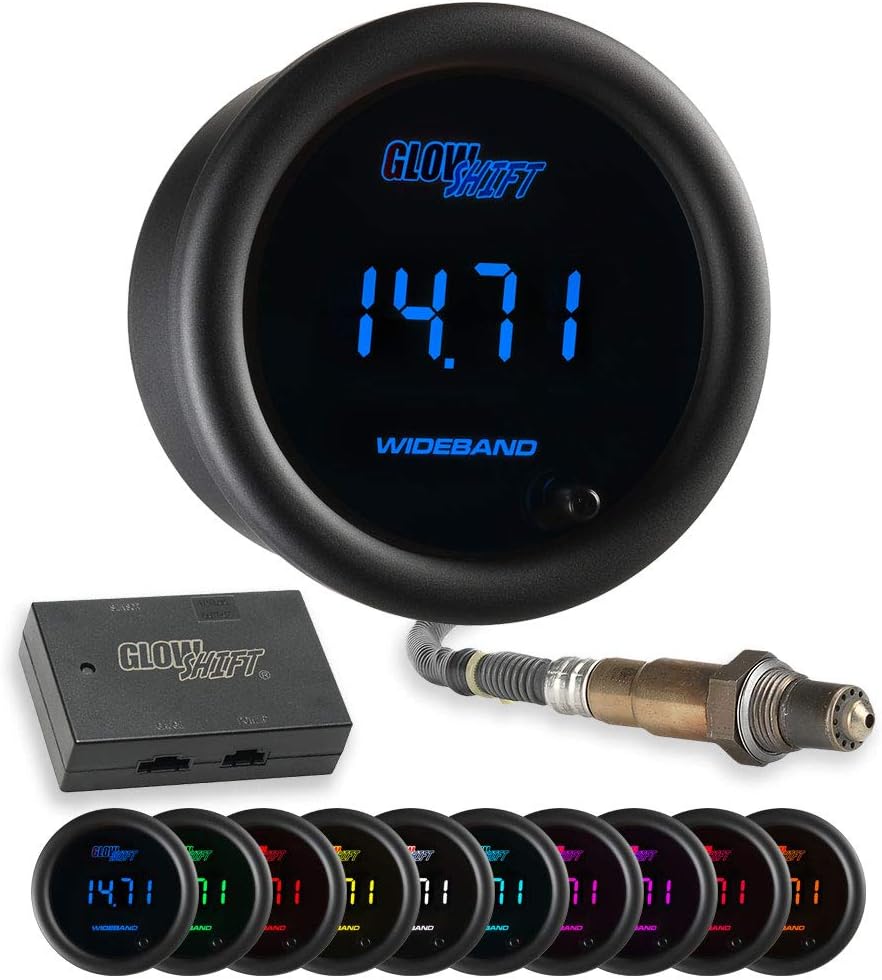
The GlowShift 10 Color Digital Wideband Air Fuel Ratio Gauge Kit combines vibrant visuals with reliable performance for performance vehicles. With a rating of 4.5, this kit offers ten solid color modes and two color cycle modes, allowing you to choose a look that matches your style or vehicle theme.
We may earn a commission when you buy through this link, at no additional cost to you.
Its standout feature is the self-calibration at startup, which ensures that the gauge is performing optimally every time you start your car. The digital display is clear and easy to read, supported by a durable build that includes a tinted lens for reduced glare.
The kit is complete with a 4.9 LSU wideband oxygen sensor, weld-in bung, control box, and all necessary harnesses. Installation is straightforward, and the included hardware ensures you have everything required to mount the gauge and sensor securely.
This kit is ideal for drivers who want a high-visibility gauge with a strong warranty backing. With free lifetime technical support and a one-year limited warranty, GlowShift provides confidence that your investment is protected for the long haul.
Self-calibration at startup maintains accuracy without manual intervention, simplifying routine engine monitoring.
Ten color modes offer unmatched flexibility for interior design matching compared to standard single-color gauges.
We may earn a commission when you buy through this link, at no additional cost to you.
Selecting the right aftermarket O2 system requires understanding your vehicle's needs, your tuning goals, and the compatibility of available components.
The heart of any O2 system is the sensor. Wideband sensors like the LSU 4.9 provide high precision across a broad range of air fuel ratios, unlike standard narrowband sensors that only read near stoichiometric. Look for sensors that offer fast response times to capture transient engine changes accurately.
Prioritize sensors with proven track records and compatibility with your fuel type to ensure reliable data under all conditions.
How you view the data matters just as much as the data itself. Digital displays with LED indicators or color-coded needles help you interpret rich or lean conditions at a glance without distraction. Ensure the display is bright enough to read in sunlight but dimmable for night driving.
Choose a display style that fits your dashboard and offers clear numerical or visual feedback for real-time tuning.
Installation complexity can vary widely between kits. Some come with complete harnesses and simple plug-and-play controllers, while others require professional welding and complex routing. Check the kit contents for mounting brackets, grommets, and instructions to gauge the effort required.
Opt for a system with clear instructions and standard 52mm housing if you plan to install it yourself to save time and frustration.
For serious tuning, the ability to log data is essential. Advanced systems allow you to record AFR data to an SD card or interface with OBD-II ports for detailed analysis later. This feature helps you verify tune changes and identify trends over multiple driving sessions.
If data logging is a priority, look for units with analog outputs or direct SD card logging capabilities to match your diagnostic workflow.
Not all systems work equally well with different fuels. Gasoline, E85, diesel, and methanol require specific sensor calibration and range settings. Verify that the product supports your specific fuel type to avoid inaccurate readings that could lead to engine damage.
Always confirm fuel flexibility before purchasing if you plan to switch fuels or run ethanol blends regularly in your vehicle.
Engine bays are harsh environments with high heat, vibration, and exposure to chemicals. Choose systems with robust sensor housing and controllers that are rated for high temperatures. Rust protection coatings and sealed connectors add significant longevity to the components.
Look for units with quality build materials and warranties that cover environmental stress to ensure long-term reliability.
Prices for aftermarket O2 systems range from basic sensors to full dual-gauge kits with logging features. Determine your primary needs—whether just a visual alert or detailed logging—to find the best balance between cost and capability.
Investing slightly more in proven sensor technology often pays off in safety and performance compared to cheaper, less reliable units.
Technical support is invaluable when dealing with installation or calibration issues. Brands that offer lifetime technical support and generous warranties demonstrate confidence in their products and care about customer success.
Check the warranty terms and customer service reputation before buying to ensure help is available if the system fails or needs configuration.
When installing, place the sensor bung at least six inches upstream of the catalytic converter and avoid welding directly on baffle ribs to ensure clean airflow. Use anti-seize compound on sensor threads to prevent seizure due to heat and corrosion over time.
Regularly calibrate the system if recommended, or trust factory trim modes for convenience. Keep the controller box clean and dry to prevent electrical shorts, especially in dusty or wet environments like off-road driving or winter conditions.
Monitor the status LED for warnings on sensor health or connection issues. If the system stops updating, check wiring connections and ensure the ground is secure before assuming sensor failure, and consider replacing the sensor if readings drift or freeze.
Narrowband sensors provide limited accuracy around the stoichiometric ratio and are mainly used for basic fuel control. Wideband sensors measure air fuel ratios across a much broader range, offering the precision needed for performance tuning and fuel economy optimization in high-stress conditions.
While not strictly necessary for stock driving, a wideband sensor can alert you to dangerous lean or rich conditions that could damage the engine. For performance enthusiasts or those with modified engines, it is a valuable diagnostic tool to ensure engine health and safety.
The lifespan of an LSU 4.9 sensor can vary from 50,000 to over 100,000 miles depending on engine conditions and usage. Factors like oil contamination, excessive heat, and fuel quality can shorten this lifespan, so regular monitoring is recommended.
Many kits are designed for DIY installation with detailed instructions and standard 52mm mounts. However, welding the sensor bung may require specialized skills or a professional if you are not comfortable with exhaust work, depending on your experience level.
Inconsistent readings can result from poor sensor placement, electrical interference, or loose wiring connections. Ensure the sensor is positioned correctly in the exhaust stream and that all grounds are secure to maintain stable and reliable data output.
Some wideband sensors are specifically calibrated for diesel and other alternative fuels. Always verify the product specifications to confirm compatibility with your fuel type, as standard gasoline sensors may not provide accurate data for diesel combustion profiles.
An analog output sends a voltage signal corresponding to the air fuel ratio, allowing the data to be logged by external devices or ECU systems. This feature is useful for users who want to record data beyond what the gauge itself displays.
Choosing the right aftermarket O2 system depends on your specific tuning needs and vehicle configuration. Whether you need a simple visual alert like the Universal Digital Wideband AFR Gauge or a full dual-channel solution like the GlowShift Black 7 Color Dual Wideband kit, each option provides critical insights into engine health.
Prioritize accuracy, ease of use, and compatibility with your engine management system to ensure you get reliable data for every drive. Investing in quality sensors and controllers prevents costly damage and helps you maximize performance safely and efficiently.
Remember that prices and availability change frequently, so always check current listings before making your final decision. With the right monitoring system, you can tune your vehicle with confidence knowing exactly what is happening under the hood.