
MINISFORUM MS-S1 MAX Mini AI Workstation PC
4.5Editor score
128GB unified LPDDR5x memory
Dual cluster setup capability for scaling
Ryzen AI Max+ 395 APU
This guide compares the top dual GPU AI setups for local LLM inference and training, featuring workstation cards, servers, and mini clusters for developers.
Building a powerful dual GPU AI setup is essential for running large language models locally without relying on expensive cloud services. These systems combine high compute power with massive memory capacity to handle complex inference and training tasks efficiently for professionals and hobbyists alike.
We evaluated ten leading configurations ranging from compact mini stations to enterprise-grade rack servers. Our analysis focused on VRAM capacity, throughput performance, software compatibility, and cooling efficiency to ensure each recommendation meets demanding workloads in real-world scenarios.
Each pick highlights unique strengths like unified memory designs or specialized GPU integration for specific use cases. Keep in mind that hardware pricing fluctuates frequently so verify current availability and costs before making your final purchasing decision for your project.
4.5Editor score

4.0Editor score

4.0Editor score
The following table provides a side-by-side comparison of all ten dual GPU AI setups reviewed in this guide. It highlights key specifications including processor types, GPU configurations, memory capacities, and cooling solutions to help you quickly identify the best fit for your specific AI development needs.


This unique graphics card combines two Intel Arc Pro B60 GPUs into a single PCIe form factor delivering massive 48GB VRAM on a consumer-friendly interface. Its specialized architecture targets AI inference workloads allowing users to run large quantized models locally without cloud dependency.
We may earn a commission when you buy through this link, at no additional cost to you.
The dual GPU design provides 394 TOPS of combined INT8 performance with each chip independently recognized by the system for flexible task assignment. It features a turbo edition cooling solution with triple thermal design ensuring stable performance during long uninterrupted inference sessions.
While powerful the card demands a motherboard supporting PCIe x16 lane bifurcation to achieve full bandwidth on consumer platforms. This requirement limits compatibility but significantly lowers total system cost for local LLM deployment compared to enterprise multi-card setups.
Developers seeking a budget friendly yet capable setup for running 70B class models locally will find this card an excellent choice. Its native support for PyTorch and standard ISV applications simplifies integration into existing AI workflows.
The combined memory pool eliminates bottlenecks by allowing seamless data transfer between GPU cores for faster model execution.
Native support for popular frameworks like vLLM and IPEX-LLM ensures easy deployment of open-source AI models without heavy modification.
We may earn a commission when you buy through this link, at no additional cost to you.
This workstation offers a complete turnkey solution for AI professionals needing maximum performance in a single package. It pairs the latest AMD Ryzen 9-9950X processor with dual RTX PRO 6000 Blackwell GPUs providing exceptional compute power for complex tasks.
We may earn a commission when you buy through this link, at no additional cost to you.
The system includes 256GB of high-speed DDR5 RAM and 8TB of NVMe SSD storage in RAID configuration ensuring data bottlenecks are minimized. Liquid cooling keeps the hardware stable under sustained loads critical for long training runs or heavy inference workloads.
Users pay a premium for the convenience of a prebuilt system that arrives fully tested with professional cable management. However the cost reflects enterprise grade components that may exceed the budget of hobbyists or small startups.
Ideal for research labs or enterprises requiring reliable local AI infrastructure this workstation delivers speed and stability. It eliminates the hassle of component compatibility issues by providing a fully integrated and supported environment out of the box.
Custom built and stress tested systems ensure consistent operation during mission critical AI projects without unexpected hardware failures.
Massive SSD capacity allows storage of large datasets locally reducing latency during training and data preprocessing phases.
We may earn a commission when you buy through this link, at no additional cost to you.
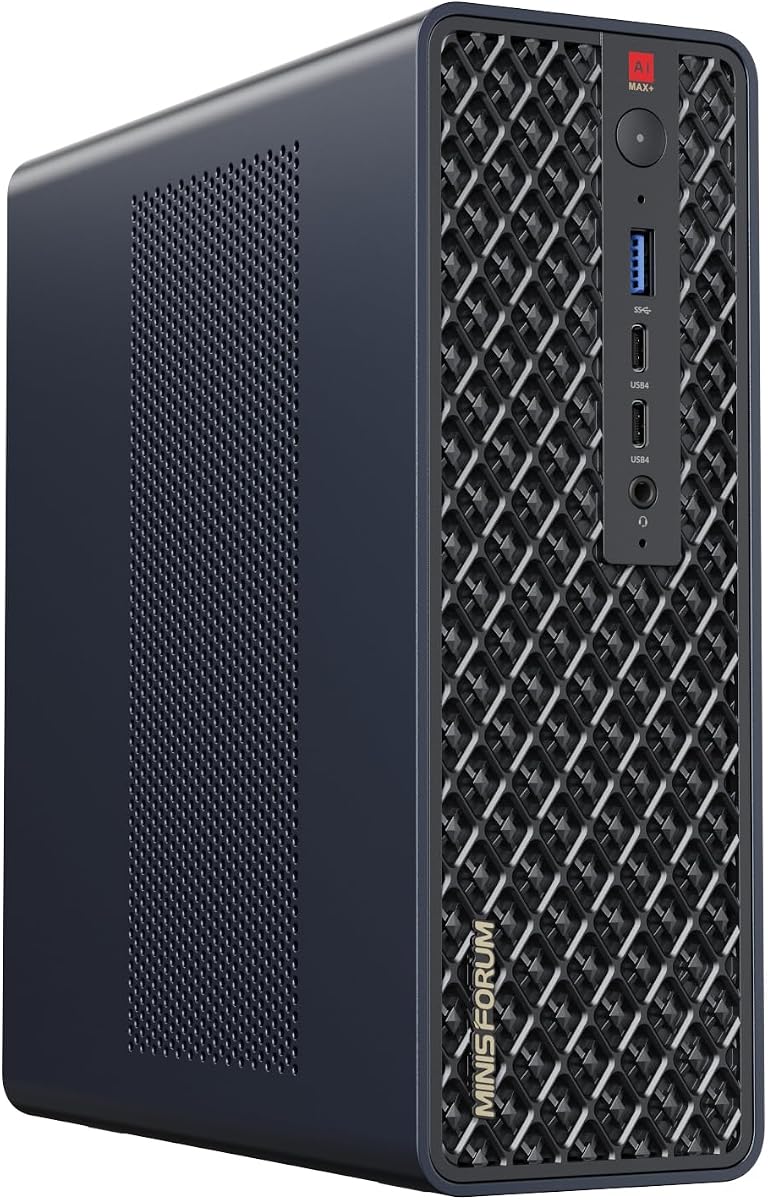
This mini workstation delivers surprising AI performance in a tiny chassis ideal for users with limited desk space. The AMD Ryzen AI Max+ 395 integrates CPU GPU and NPU into one powerful APU delivering 126 TOPS total system output.
We may earn a commission when you buy through this link, at no additional cost to you.
Equipped with 128GB LPDDR5x RAM this system uses unified memory to eliminate VRAM bottlenecks ensuring smooth high intensity computations. Its cluster design allows two units to be combined to run massive 235B models locally achieving speeds over 10 tokens per second.
Despite its size the MS-S1 MAX supports PCIe x16 expansion and offers dual 10GbE LAN plus USB4 V2 connectivity for fast data transfer. The aerospace-grade aluminum chassis and advanced cooling maintain stable temperatures even under continuous load conditions.
Perfect for developers building distributed AI centers or needing portable high compute power this unit offers versatility. It is a cost-effective entry into local AI processing that scales through clustering rather than buying expensive single hardware units.
Multiple units can be cascaded to create a high-efficiency distributed computing center for large model inference without cloud reliance.
USB4 V2 and dual 10GbE ports ensure rapid data movement essential for handling large datasets during development.
We may earn a commission when you buy through this link, at no additional cost to you.
This workstation pairs dual GeForce RTX 5090 GPUs with a powerful Ryzen 9-9950X CPU to deliver exceptional performance for AI and ML tasks. Each GPU provides 64GB of GDDR7 memory allowing users to load large models directly onto the card.
We may earn a commission when you buy through this link, at no additional cost to you.
The system includes 256GB DDR5 memory and 8TB NVMe SSD in RAID configuration to ensure fast data access during training. A 1600W power supply supports the high energy demands of the dual GPUs and CPU under heavy load conditions.
Liquid cooling on the processor maintains stable temperatures during extended sessions preventing thermal throttling that could slow down workflows. This build targets professionals needing raw speed and capacity for complex engineering and data science projects.
Ideal for those who prefer consumer grade GeForce GPUs for their extensive software support this station offers a balanced high-end solution. It provides significant compute power without the enterprise price tag of professional server grade hardware.
Access to widely supported CUDA libraries and tools makes deployment of open-source AI models seamless and efficient.
GDDR7 memory on 5090 GPUs provides ultra fast data transfer reducing wait times for inference and training iterations.
We may earn a commission when you buy through this link, at no additional cost to you.
Bringing supercomputer performance to your desk this pack features the GB10 Grace Blackwell chip delivering up to 1 petaFLOP of AI performance. It is designed for local model fine-tuning inference and analytics accelerating time to solution significantly.
We may earn a commission when you buy through this link, at no additional cost to you.
Each unit offers 128GB of unified memory allowing you to experiment with large models up to 200 billion parameters directly on your desktop. The seamless integration of NVIDIA AI software stack simplifies development workflows and deployment across different environments.
Energy efficient and compact this system augments existing resources like laptops or clouds by providing a dedicated high-performance node. It empowers rapid testing and iteration driving innovation in secure local settings without relying on external servers.
Perfect for enterprises needing secure local infrastructure this setup offers exceptional ROI through increased productivity and speed. It allows developers to prototype and validate ideas quickly using massive capacity in a manageable desktop form factor.
Large unified memory allows seamless access to massive datasets and models without data movement overhead for faster results.
Pre-integrated with NVIDIA AI software stack ensures compatibility with major frameworks reducing setup time and errors.
We may earn a commission when you buy through this link, at no additional cost to you.
Designed for HPC clusters this server houses up to eight RTX PRO 6000 Blackwell GPUs delivering unparalleled parallel processing power. Equipped with dual EPYC 9965 processors it supports 192 cores and 24-channel DDR5 memory for massive data throughput.
We may earn a commission when you buy through this link, at no additional cost to you.
The chassis includes hot-swap storage slots supporting up to 122TB per drive ensuring vast storage expansion for large datasets. Redundant power supplies and advanced management software enhance reliability and security for mission critical AI applications and research.
Networking capabilities support up to 10 high-bandwidth 200GbE NICs connected directly to CPU reducing latency during high-speed data transfers. Toolless design simplifies maintenance while hardware-level security ensures safe operations in shared or multi-tenant environments.
Ideal for organizations building private AI clouds or training centers this system offers high density and reliability. It scales compute resources efficiently supporting complex neural networks and massive inference tasks without relying on public cloud services.
Eight GPUs in one chassis maximize compute per square foot ideal for high-performance data centers and research labs.
Integrated control center software provides remote monitoring and hardware-level security for protecting valuable AI infrastructure.
We may earn a commission when you buy through this link, at no additional cost to you.
Tailored for PIX4Dsurvey and demanding ML tasks this workstation features a 32 core Threadripper 9970X CPU for exceptional multi-threaded performance. It includes a RTX 5090 GPU with 32GB VRAM delivering high-speed rendering and AI compute capabilities.
We may earn a commission when you buy through this link, at no additional cost to you.
System stability is enhanced by 128GB ECC Reg DDR5 RAM and 360mm AIO CPU liquid cooling ensuring consistent operation under load. The 1600W Platinum PSU provides ample power for GPU and CPU spikes during intensive processing jobs.
Networking options include onboard 10GbE LAN plus standard Ethernet and Wi-Fi 7 for fast data transfers essential for large datasets. Custom cable management and stress testing ensure reliable performance for professional workflows in design and data science.
Ideal for engineers and scientists needing high local compute this station balances speed and reliability. Its specialized configuration supports complex physics simulations and deep learning tasks requiring both CPU and GPU power.
Error correcting memory protects data integrity during long training sessions and critical processing tasks.
32 core Threadripper CPU accelerates preprocessing tasks and data analysis for faster overall workflow times.
We may earn a commission when you buy through this link, at no additional cost to you.
This workstation leverages a groundbreaking 192-core AMD EPYC 9965 processor to deliver unmatched multi-threaded processing for local AI training. It includes triple RTX PRO 6000 Blackwell GPUs providing 288GB total VRAM for complex neural network models and simulations.
We may earn a commission when you buy through this link, at no additional cost to you.
With 768GB of DDR5 ECC RAM and 8TB Gen5 NVMe storage data pipelines run at blazing speeds without bottlenecks. The system arrives turnkey with Windows 11 Pro and a keyboard mouse ready for immediate deployment in offices or labs.
Designed for high-density 4U chassis environments this setup supports mission critical uptime with a 2800W Titanium PSU. Built to last with US assembly and rigorous stress testing it offers lifetime technical support and strong warranty coverage.
Ideal for research teams needing extreme local capacity this workstation removes cloud latency for faster iteration. It balances raw compute power with reliability suitable for heavy engineering AI and generative design workflows.
768GB RAM pool handles large datasets and models in memory eliminating bottlenecks during training and analytics.
Gen5 NVMe SSDs provide blistering read write speeds for instant data ingestion and manipulation during analysis.
We may earn a commission when you buy through this link, at no additional cost to you.
Engineered for agentic workflows this GPU packs 96GB of next-gen GDDR7 ECC memory into a dual slot professional form factor. It eliminates VRAM bottlenecks enabling teams to host heavy open-source LLMs locally without cloud overhead or latency.
We may earn a commission when you buy through this link, at no additional cost to you.
Built on Blackwell architecture the card delivers up to 3,511 TOPS of AI performance while capping power at 300 Watts for efficiency. It features advanced thermal management making multi-GPU scaling viable for research labs and development studios.
With 24,064 CUDA cores and 188 ray tracing cores it handles real-time 3D environments and path tracing with ease. The 1,792 GB/s memory bandwidth ensures zero-lag multi-stream editing for video production and virtual production pipelines.
Ideal for creative professionals and researchers needing high capacity in a desktop this GPU offers unmatched speed and reliability. Its Max-Q design balances performance and efficiency for sustained AI rendering and compute workloads.
Blistering memory bandwidth ensures data flows fast during inference and video editing preventing slowdowns.
Error correcting memory protects against data corruption during long running critical computation tasks.
We may earn a commission when you buy through this link, at no additional cost to you.
Featuring five 8K video outputs this mini PC supports multiple monitor displays for expansive workflows in engineering and design. It uses the Ryzen AI Max+ 395 processor and Radeon 8060S graphics delivering high efficiency performance in a compact chassis.
We may earn a commission when you buy through this link, at no additional cost to you.
Equipped with 128GB LPDDR5 RAM and 2TB NVMe SSD it handles multimedia and compute tasks efficiently with minimal latency. Advanced cooling ensures stable performance while dual 10G LAN ports enable high-speed networking for fast data transfer.
Storage expansion is flexible with a second M.2 slot supporting up to 8TB and optional RAID configurations for data safety. The slide-out design facilitates upgrades and maintenance adapting to personal or enterprise rack environments easily.
Ideal for traders digital signage and remote engineers needing multi-display power this unit offers portability and speed. It maximizes productivity through superior connectivity and display capabilities without needing a full tower workstation.
Five 8K outputs allow simultaneous viewing of complex designs and data panels for increased workflow efficiency.
Glacier cooling system with phase change ensures quiet stable performance even under peak power loads.
We may earn a commission when you buy through this link, at no additional cost to you.
Selecting the right dual GPU AI setup involves evaluating several critical factors including memory capacity processor power and thermal management. This guide explores the key components and considerations to help you choose a system that meets your specific AI development requirements.
Video RAM (VRAM) is crucial for storing large AI models and datasets during processing. Larger VRAM allows you to run more complex models locally without relying on cloud services. Look for systems offering unified memory or high capacity GDDR7 or HBM3e options for better performance.
Prioritize setups with at least 48GB total VRAM for running large language models efficiently. Unified memory designs reduce data movement overhead improving inference speeds significantly.
Choose GPUs that align with your software stack whether NVIDIA CUDA or Intel oneAPI. Ensure the GPUs support the AI frameworks you use like PyTorch TensorFlow or vLLM. Compatibility affects ease of setup and ongoing maintenance.
Verify that the system supports the specific model types you plan to run. Some specialized cards like the Arc Pro B60 target inference specifically while others are built for general compute.
A powerful CPU and sufficient system RAM are necessary to prevent bottlenecks during data preprocessing. Look for high core count CPUs like EPYC or Ryzen Threadripper paired with ECC DDR5 RAM for stability.
Balance CPU and GPU resources so neither limits the other. Sufficient system RAM ensures smooth data flow between CPU and GPU during training phases.
Dual GPU systems demand robust power supplies with headroom for peak loads. Adequate cooling via liquid or advanced airflow systems maintains performance under sustained workloads preventing throttling.
Check that your PSU wattage matches system needs and that thermal design supports continuous operation. Liquid cooling or efficient fans extend hardware lifespan and reliability.
Consider the physical size and mounting options based on your workspace. Desktop towers offer flexibility while rackmount servers fit data centers. Ensure PCIe expansion slots support additional GPUs or storage.
Select a form factor that accommodates your cooling and space constraints. Expansion options allow future upgrades as AI workloads grow over time.
High-speed network ports like 10GbE or 200GbE are essential for transferring large datasets efficiently. Multiple video outputs and USB ports support peripheral connectivity for multi-monitor setups.
Verify network capabilities match data transfer needs. Fast I/O prevents data ingestion bottlenecks and keeps training pipelines running smoothly.
Software support for AI frameworks and drivers affects deployment ease. Systems preloaded with necessary drivers or offering native integration reduce setup time and potential issues.
Choose platforms with strong community or vendor support for AI frameworks. Native support for libraries simplifies installation and optimization.
Evaluate the total cost including hardware and potential maintenance. Consider long-term ROI from reduced cloud costs and faster development cycles.
Balance initial investment with performance benefits. Cost-effective solutions like mini clusters can scale affordably over time.
Start by installing compatible drivers and AI frameworks like PyTorch or TensorFlow before loading large models. Verify GPU detection using system monitoring tools to ensure both units are recognized correctly for parallel processing.
Maintain proper airflow and cooling by regularly cleaning dust filters and checking thermal paste integrity. Use software utilities to monitor GPU temperatures and adjust fan speeds to prevent overheating during long inference sessions.
Schedule regular system updates and driver patches to ensure security and performance stability. Back up your models and datasets to external storage to prevent data loss during hardware maintenance or unexpected failures.
To run 70B class quantized models locally you typically need at least 48GB of VRAM. Some specialized cards like the Intel Arc Pro B60 combine dual GPUs to provide this capacity in a single PCIe card eliminating multi-card complexity.
Yes some mini PCs like the MINISFORUM MS-S1 MAX use unified memory and clustering to emulate multi GPU performance. While not replacing full towers they offer scalable and portable solutions for local inference tasks efficiently.
Liquid cooling is highly recommended for dual GPU workstations to manage heat efficiently during extended workloads. It maintains stable temperatures preventing throttling which ensures consistent performance for long inference and training sessions.
Most modern GPUs from NVIDIA and Intel support popular AI frameworks like PyTorch and TensorFlow. However check specific compatibility for optimized libraries like IPEX-LLM to ensure maximum performance on your chosen hardware setup.
You can scale by clustering multiple mini workstations or upgrading to server chassis supporting more GPU slots. Mini clusters allow distributed computing for massive models while servers provide centralized high-density compute power.
Dual GPU workstations often require 1600W to 3200W power supplies depending on GPU and CPU draw. Ensure the PSU has enough PCIe connectors and efficiency rating to handle peak loads without instability or voltage drops.
Unified memory allows CPU and GPU to access a shared memory pool reducing data transfer overhead. This improves speed and reduces bottlenecks during large model inference making it ideal for complex AI workflows and high concurrency tasks.
Consumer GPUs often offer better cost to performance ratios for inference while workstation GPUs provide ECC memory and stability for mission critical training. Your choice depends on budget and need for reliability and advanced features.
The top picks including the WEELIAO MAXSUN Arc Pro B60 and MINISFORUM MS-S1 MAX offer versatile options for different budgets and use cases. These systems balance VRAM capacity performance and cost to meet diverse local AI inference needs effectively.
When choosing prioritize VRAM capacity and software compatibility to ensure smooth operation with your preferred AI frameworks. Consider cooling and power requirements to maintain stability during extended workloads and prevent thermal throttling issues.
Prices for AI hardware fluctuate frequently so verify current costs and availability before purchasing your final setup. Always check for recent driver updates and software support to maximize performance and longevity of your dual GPU configuration.