
VIVOSUN Digital Hygrometer Thermometer
4.2Editor score
Dual channel sensor support
Bluetooth app connectivity
Visualized VPD design
This guide compares the top 10 grow room monitoring tools for 2026, analyzing accuracy, smart features, and sensor types to help cultivators choose the perfect
Effective grow room monitoring is essential for optimizing plant health and maximizing yields in any cultivation environment. Keeping track of temperature, humidity, and other vital metrics ensures your crops thrive without risking mold or stress.
We compared ten leading monitoring devices based on sensor accuracy, connectivity options, app functionality, and ease of use. Our analysis covers everything from basic hygrometers to advanced systems with CO2 and light detection capabilities.
Each pick in this list highlights specific strengths for different grow setups, whether you need a simple tent monitor or a comprehensive greenhouse solution. Note that product availability and pricing may change, so verify details before purchasing.
4.2Editor score

5.0Editor score

4.6Editor score
The following table provides a side-by-side comparison of the top ten grow room monitoring devices. We highlight key specifications including sensor types, connectivity methods, and unique features to help you quickly identify the best fit for your setup.




The VIVOSUN Digital Hygrometer Thermometer stands out as a highly accessible tool for growers who need reliable climate data without breaking the bank. With a rating of 4.2 stars, this device offers a robust balance of accuracy and ease of use for hobbyists and small scale cultivators.
We may earn a commission when you buy through this link, at no additional cost to you.
Its standout quality is the ability to use a built-in sensor alongside an optional external probe for dual-channel monitoring. This allows you to compare internal tent air versus ambient room conditions. The app integration provides real-time updates and alerts when your VPD levels drift outside safe zones.
While it lacks WiFi connectivity compared to more expensive units, the Bluetooth range is sufficient for most indoor setups. The two-year free data storage service is a significant advantage for tracking long-term environmental trends and adjusting your grow cycles accordingly.
This device is ideal for growers managing a single tent or a small room where remote access isn't critical. If you need to monitor multiple locations far apart, consider a WiFi model. Otherwise, this is a top choice for budget-conscious monitoring.
The dual channel feature allows for precise comparison between different zones in your grow area, ensuring consistent conditions throughout the space.
Visualizing VPD directly on the device helps you instantly understand if plants are at risk of transpiration issues without needing to do math.
We may earn a commission when you buy through this link, at no additional cost to you.
The AC Infinity Temperature Humidity VPD Smart Hygrometer B1 is designed for accuracy and convenience. With a 4.1 rating, it is a solid option for growers who want to track VPD specifically without needing complex controllers. The inclusion of a corded probe ensures precise readings where plants actually are.
We may earn a commission when you buy through this link, at no additional cost to you.
Its key strength lies in the smart app integration which provides daily highs and lows, as well as graphical data for historical tracking. The backlit LCD screen ensures readability in dim grow tents, and the magnetic mounting option offers flexibility in placement on metal surfaces like shelving.
On the downside, reliance on Bluetooth means you must be within range to check the device directly. It lacks the remote access capabilities of WiFi devices, which could be a drawback if you need to monitor conditions while away from home.
This monitor is perfect for small to medium grow tents where physical proximity to the device is manageable. If you need to monitor a basement or a second room remotely, you might need to look at the Govee WiFi options. For local monitoring, this is excellent value.
The corded probe allows you to measure temperature and humidity exactly where the plants are, rather than relying on air near the unit itself.
The app provides detailed charts that help you spot trends over time, making it easier to troubleshoot issues like sudden humidity spikes.
We may earn a commission when you buy through this link, at no additional cost to you.
The GoveeLife WiFi Thermometer Hygrometer 5-in-1 is a premium choice for serious growers needing robust climate control. With a 4.6 rating, it delivers lab-grade accuracy and an industry-leading range via its included gateway. This makes it suitable for large setups or multi-room monitoring.
We may earn a commission when you buy through this link, at no additional cost to you.
Its standout quality is the 1640ft open-air range which can penetrate thick walls and basements. The device also features 4-level alerts including push, app, email, and buzzer notifications ensuring you never miss critical changes. The large LCD display with color-coded indicators makes it easy to see conditions at a glance.
While the price is higher than basic hygrometers, the precision of the sensor and the comprehensive alert system justify the cost. It tracks humidity from 0% to 99% with rapid refresh rates. The only limitation is that some advanced features require the gateway to be set up correctly.
This is the best choice for commercial grow operations or large residential greenhouses where multiple zones must be tracked reliably. If you need to monitor conditions remotely with high precision, this system provides the tools you need to prevent crop loss.
With a 1640ft range via the gateway, you can monitor a sprawling grow house or multiple rooms without signal loss or connectivity issues.
Multiple alert channels ensure you are notified via email or app even if you are away, giving you peace of mind during vacations.
We may earn a commission when you buy through this link, at no additional cost to you.
The Govee WiFi Thermometer Hygrometer H5103 features a unique electronic ink display that is easy to read from any angle. With a 4.2 rating, it combines classic readability with modern smart features. The e-ink screen mimics paper, reducing eye strain in dark grow rooms.
We may earn a commission when you buy through this link, at no additional cost to you.
Key strengths include stable WiFi and Bluetooth connectivity which allows you to check data remotely via the Govee Home App. The Swiss-made sensor ensures high accuracy for both temperature and humidity. You can set alerts to notify you instantly if conditions exceed your set ranges.
One trade-off is that it only supports 2.4G WiFi networks, which might require a separate router or adjustment on modern dual-band routers. Also, e-ink screens do not update as fast as LCDs, but for monitoring climate trends this is rarely an issue.
This unit is great for growers who want clear visibility on the device itself without needing to check a phone app constantly. The six-month battery life is impressive for a WiFi device. It works well for both home grows and small commercial setups requiring remote oversight.
The e-ink display provides a high-contrast view that remains clear in low light and does not require a backlight that could distract plants.
Having both WiFi and Bluetooth ensures you can always connect, even if your WiFi network experiences a temporary disruption or setup issue.
We may earn a commission when you buy through this link, at no additional cost to you.
The Temtop CO2 Monitor is a specialized tool for growers who need to track carbon dioxide levels in addition to standard climate metrics. With a 4.3 rating, it uses advanced NDIR technology to deliver accurate CO2 readings alongside temperature and humidity. This is crucial for optimizing photosynthesis rates.
We may earn a commission when you buy through this link, at no additional cost to you.
Its key strength is the high-precision CO2 sensor which provides reliable data within the critical range for plant growth. The 70-day battery life ensures continuous monitoring without constant battery changes. The device is small and portable, making it easy to move between different grow zones.
While it lacks WiFi connectivity and app integration found in other devices, it excels in its dedicated function. The customizable alerts allow for basic noise-free operation. However, you cannot view historical trends remotely, which limits long-term analysis compared to smart hygrometers.
This monitor is best used as a companion device in your grow room to verify CO2 enrichment levels. If you are running a CO2 system, this device helps ensure you are staying within the ideal range. It is a valuable addition to a comprehensive monitoring suite.
Using NDIR technology ensures that CO2 readings are not affected by other gases or humidity, providing precise data for yield optimization.
The compact design allows you to place it discreetly in your setup without taking up valuable space on shelves or grow beds.
We may earn a commission when you buy through this link, at no additional cost to you.
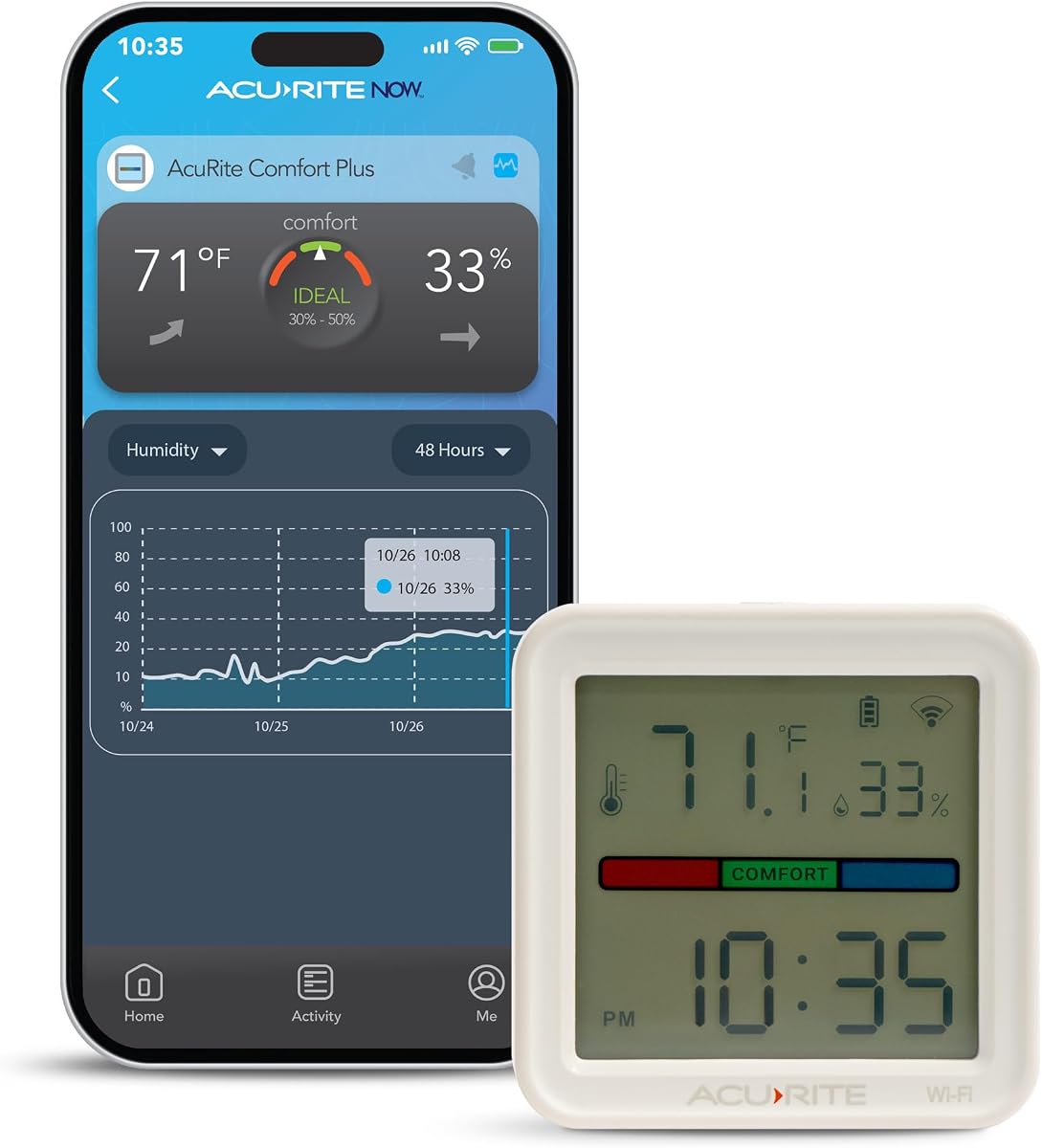
The AcuRite Smart Wi-Fi Indoor Comfort Meter is a straightforward device that brings smart connectivity to basic climate monitoring. With a 4.5 rating, it is praised for its ease of use and reliable WiFi connection. The AcuRite NOW app allows you to set alerts and track history efficiently.
We may earn a commission when you buy through this link, at no additional cost to you.
Its main strength is the simplicity of setup and the ability to view data on the go. You can track history after connecting to Wi-Fi and receive updates every 5 minutes. The digital display also functions as a clock, which is a handy addition for any grow room setup.
The sensor accuracy is decent for general purposes but may not match the precision of dedicated lab-grade instruments. Additionally, it runs on three AAA batteries which may need more frequent replacement than larger battery options. It is designed for indoor use and is not weatherproof.
This device is ideal for casual growers or small indoor gardens where extreme precision is not required. If you want a simple way to keep an eye on temperature and humidity via your phone, this is a solid and budget-friendly option to consider for your setup.
Setting up WiFi is easy and the app interface is intuitive, allowing you to start monitoring your grow space within minutes.
By combining a climate monitor with a digital clock, this device serves two purposes, saving space on your grow room shelf.
We may earn a commission when you buy through this link, at no additional cost to you.
The Govee WiFi Thermometer Hygrometer H5179 offers robust connectivity with both WiFi and Bluetooth options for reliable data access. With a 4.3 rating, it is a strong contender for growers who need real-time updates and historical data tracking. The Swiss-made sensor ensures accurate readings for temperature and humidity.
We may earn a commission when you buy through this link, at no additional cost to you.
Its standout quality is the dual connectivity which allows for flexible use. You can view data online via WiFi or locally via Bluetooth. The app provides notification alerts for out of range conditions, and the data export function lets you save up to two years of history for analysis.
A limitation is that alerts are only available via Bluetooth settings in some versions, and it does not support 5G WiFi networks. However, the 2.4G support is standard for smart home devices. The refresh rate of every 2 seconds ensures you stay updated on environmental changes.
This is an excellent choice for growers who value data export capabilities to track seasonal trends. The ability to use a widget on your phone home screen makes monitoring even easier. It is a versatile device for both home and professional grow setups.
Having both WiFi and Bluetooth ensures you can access data even if one connection method is interrupted, providing a backup system.
The widget support allows you to see temperature and humidity at a glance on your phone home screen without opening the app.
We may earn a commission when you buy through this link, at no additional cost to you.
The Govee Indoor Hygrometer Thermometer 2Pack H5075 offers great value by providing two devices for the price of one. With a 4.5 rating, these units are praised for their accuracy and clear displays. You can place one inside the tent and one outside to track environmental differences easily.
We may earn a commission when you buy through this link, at no additional cost to you.
Key strengths include the large LCD screen which displays numbers clearly for quick checks. The app allows you to set alerts for out of range conditions and export up to two years of data. The comfort indicators help you visually gauge if the environment is dry, wet, or optimal.
The main limitation is that it relies solely on Bluetooth for app connectivity. This means you cannot check data remotely if you are not within range. If you need remote monitoring, you would need a WiFi model. However, the price is lower, making it budget friendly.
This pack is ideal for growers managing multiple small tents or areas within a room. The two pack format allows for comprehensive local coverage without expensive equipment. If remote access is not a priority, this is one of the most cost-effective solutions available.
With two devices in the pack, you can monitor distinct zones separately, ensuring consistent conditions across your entire growing area.
The three level comfort indicators provide an at-a-glance assessment of conditions, helping you make quick adjustments without checking the app.
We may earn a commission when you buy through this link, at no additional cost to you.
The GoveeLife 2.0 WiFi Hygrometer Thermometer 6-Pack is a scalable system that allows you to monitor multiple points simultaneously. With a 4.5 rating, it is highly recommended for complex setups. The included gateway connects to WiFi, allowing remote monitoring of all six sensors from one dashboard.
We may earn a commission when you buy through this link, at no additional cost to you.
Its standout feature is the compact size of the sensors, which can be placed in drawers, corners, or even on shelves without taking up space. The sensors last up to two years on batteries, reducing maintenance. You can receive remote alarms via app and email when conditions change.
One trade-off is that setup requires configuring the gateway first, which might be slightly more complex than plugging in a standalone unit. Also, the sensor supports only 2.4G WiFi networks. Once set up, the remote alarm function provides peace of mind when you are away.
This system is perfect for large grow operations or multi-room monitoring where consistency across zones is key. If you need to track temperature in different tents and compare them easily, this 6-pack system provides the necessary tools and scalability.
With six sensors in a pack, you can map your entire grow space and ensure even air distribution and consistent conditions everywhere.
The two year battery life minimizes the need for frequent battery replacements, making it a low maintenance solution for long-term monitoring.
We may earn a commission when you buy through this link, at no additional cost to you.
The Pulse One Smart Grow Room Monitor is the top choice for serious cultivators who demand comprehensive environmental data. With a 5.0 rating, it offers unmatched versatility by tracking VPD, dew point, and light intensity in addition to temperature and humidity. It is designed to prevent crop loss and boost yields.
We may earn a commission when you buy through this link, at no additional cost to you.
Its key strengths lie in the multi-sensor array and cross-platform support. Whether you use iOS, Android, or Windows, you can access the dashboard easily. The device stores data offline and alerts you to connectivity issues ensuring you never lose track of your environment. The US-based support team adds confidence.
The trade-off is the higher price point compared to standard hygrometers. However, the integration of light intensity monitoring is unique and highly useful for growers who need to ensure optimal lighting conditions. The splash resistant design adds durability in humid grow environments.
This device is best for professional growers who need detailed metrics like dew point to prevent mold and disease. If you want a one-stop solution for all environmental factors affecting yield, this monitor provides the most complete data package available on the market today.
Measuring light intensity directly from the unit helps you verify your grow lights are delivering the expected PPFD without needing a separate meter.
Tracking dew point is essential for preventing condensation on leaves, which can lead to mold and other fungal issues in your grow room.
We may earn a commission when you buy through this link, at no additional cost to you.
Selecting the right monitoring tool depends on your specific grow setup and the metrics you need to track. This guide outlines the key factors to consider before making a purchase to ensure you get a device that fits your workflow and environment.
Accuracy is critical because even small fluctuations in temperature or humidity can impact plant health. Look for devices with Swiss-made sensors or those that offer ±0.5°F or better accuracy. Some premium units provide lab-grade precision which is essential for controlling VPD and dew point effectively.
Choose a device with high precision sensors to ensure reliable data and better decision-making for your grow cycles.
Decide whether you need Bluetooth or WiFi connectivity based on your usage habits. Bluetooth is cheaper and works well if you are often near the grow room, but WiFi allows remote access via apps. This is vital if you want to check conditions from work or while traveling.
WiFi connectivity offers remote monitoring which is essential for growers who are not always at home to check conditions manually.
A clear display is necessary for quick checks without opening an app. LCD screens are common, but electronic ink displays save power and reduce glare. Consider a device with a backlight if your grow room is dark, or one with large numbers for elderly users.
Select a display type that suits your lighting conditions and reading preferences for quick and easy access to data.
The ability to store and export historical data helps you identify trends and troubleshoot issues. Devices that offer cloud storage or CSV export allow you to analyze temperature swings over time. Look for options that keep data for at least 30 days or more for meaningful analysis.
Ensure the device offers long-term data storage so you can track environmental trends over your entire grow cycle.
Alerts are a safety net that notify you when conditions go out of range. Some devices send push notifications or emails, while others use sound alarms. For critical environments, email alerts are valuable as they ensure you get the message even if the app is not open.
Prioritize devices with customizable alerts to prevent crop loss from sudden temperature or humidity spikes.
Battery life varies significantly between Bluetooth and WiFi devices. Bluetooth units often last years on AA batteries, while WiFi units may need monthly charging or replacement. If you do not want to deal with frequent battery changes, consider a USB powered option or one with a rechargeable battery.
Look for long battery life to minimize maintenance and ensure your device does not go offline unexpectedly during a grow cycle.
Some growers need more than just temperature and humidity. CO2 monitors, VPD displays, and light intensity sensors are specialized tools that cater to advanced cultivation. If you are running a CO2 system or managing VPD tightly, ensure the device supports these specific metrics.
Check if the device supports specialized metrics like VPD, CO2, or light if your grow strategy requires these additional data points.
The ease of installation matters for getting accurate readings. Devices with wall mounting, magnetic backs, or lanyards make it easy to place the sensor exactly where you need it. Ensure the device is portable enough to move between zones for calibration.
Choose a unit with flexible mounting options to ensure the sensor is placed in the most relevant location for your plants.
To ensure accurate readings, place your monitor away from direct heat sources like lights or vents. Positioning the device at plant canopy height provides the most relevant data for your crop's immediate environment.
Regularly calibrate your device using ice water or salt solutions if the manufacturer allows it. Keeping the sensor clean and free from dust ensures that humidity and temperature readings remain reliable over time.
Update the device firmware regularly to access new features and improve stability. Check your battery levels every few months to prevent unexpected downtime, especially if you rely on the device for critical alerts.
VPD stands for Vapor Pressure Deficit and measures the difference between the amount of moisture in the air and how much moisture the air can hold when saturated. It is important because it helps you determine if plants are stressed or transpiring properly. Monitoring VPD helps prevent mold and ensures optimal growth.
Not necessarily. If you are physically present in the grow room regularly, a Bluetooth device may suffice. However, if you need to check conditions remotely or receive alerts when away from home, a WiFi device is necessary to allow access via your smartphone from anywhere.
It is recommended to calibrate your sensor every three to six months depending on usage and environmental conditions. Frequent monitoring of sensitive plants may require more regular calibration to ensure precision. Always follow the manufacturer's instructions for the best results.
Most indoor hygrometers are not designed for outdoor use and may fail in rain or extreme heat. If you need to monitor an outdoor greenhouse, choose a device rated for outdoor conditions or one that is waterproof. Always check the product specifications before outdoor installation.
The ideal temperature range depends on the stage of growth and plant type, but generally 70°F to 85°F during lights on is standard. Lower temperatures are preferred during the dark cycle to mimic night conditions. Using a monitor helps you stay within these ranges to prevent heat stress.
Humidity fluctuates due to factors like plant transpiration, ventilation, and watering schedules. When lights are on, heat rises and can lower relative humidity. Using a monitor helps you track these patterns so you can adjust fans or humidifiers accordingly to maintain stability.
The best monitor for you depends on your specific needs and budget. For budget-conscious growers, the VIVOSUN Digital Hygrometer offers a solid entry point. For those seeking premium features and accuracy, the Pulse One provides comprehensive data tracking.
Prioritize devices that offer the level of connectivity and data access you require. If remote alerts are essential, ensure you choose a WiFi model. If physical presence is guaranteed, a Bluetooth unit might save you money without sacrificing performance.
Remember to check current prices and availability as deals change frequently. Investing in the right monitoring tool can save your crops and improve yields significantly. Choose a device that fits your workflow to ensure consistent and optimal growing conditions.