
Askar 71F Flat-Field Telescope
4.9Editor score
Quadruplet air-spaced design
Integrated field flattening optics
Compact 2.5kg tube weight
This guide compares the top apochromatic refractors for visual use and astrophotography to help you choose the best optical system for your stargazing needs.
Apochromatic refractors are the gold standard for clear, sharp views of the night sky. These telescopes use special glass to eliminate color fringing and deliver crisp images of stars and planets without the blur found in cheaper models.
We evaluated ten leading models based on optical quality, build durability, and value for money. Each entry in this list offers unique strengths, from compact travel scopes to larger apertures designed for deep sky imaging and professional astrophotography work.
Every pick includes detailed specs, pros, cons, and specific use cases to match your goals. Note that availability and pricing can fluctuate frequently, so checking current listings is always recommended before making your final purchase decision today.
4.9Editor score

4.5Editor score

4.8Editor score
This side-by-side comparison highlights the key specifications and capabilities of each telescope in our list. Use this table to quickly identify which model offers the ideal aperture, focal ratio, and accessories for your specific viewing or imaging goals.




This SVBONY SV550 AP0 is a top-tier apochromatic refractor designed for serious visual observation and astrophotography. With a 4.5 star rating, it stands out for its triplet optics that effectively correct blue-edge chromatic aberration found in cheaper telescopes.
We may earn a commission when you buy through this link, at no additional cost to you.
The air-spaced triplet optical design uses a piece of S-FPL51 low-dispersion ED glass to produce bright, high-contrast images. Its 2.5-inch magnesium alloy dual-speed focus mount reduces weight significantly, making the support platform lighter and easier to handle during long sessions.
While the OTA is excellent, you will need to invest in a mount and accessories separately. This means the initial cost is higher than bundled sets, but it offers flexibility for users who already have mounting gear or prefer customizing their rig.
If you want a reliable scope for exploring galaxies and star clusters with high clarity, this is a strong choice. It is particularly well-suited for observers who value optical precision and lightweight construction for portable stargazing adventures under the stars.
The combination of one ED glass piece and two correction pieces reduces fringing and improves edge sharpness significantly.
The magnesium alloy focus mount offers the same durability as aluminum but weighs over twenty percent less for easier transport.
We may earn a commission when you buy through this link, at no additional cost to you.
The Explore Scientific ED80 is renowned for its brilliant, high-contrast views thanks to genuine FCD1 HOYA extra-low dispersion glass. It holds a 4.2 star rating and is a fantastic option for those who want detailed planetary and deep sky imagery without bulk.
We may earn a commission when you buy through this link, at no additional cost to you.
Its air-spaced triplet optical design virtually eliminates chromatic aberrations, making it great for astrophotography. The 480mm focal length and retractable dew shield ensure this portable refractor is perfect for spontaneous sessions or guiding duties on larger telescopes.
One drawback is the potentially higher price point compared to similar scopes. Additionally, users may find they need to purchase specific adapters or accessories separately to optimize it for their existing camera setups or mounting systems effectively.
This scope is ideal for astrophotographers who need a reliable guide scope or portable imaging tool. If you value premium glass and local customer service support, this model delivers exceptional clarity and detail for both visual and imaging applications.
The FCD1 HOYA glass ensures stunning details and color fidelity across all optical surfaces with proprietary multi-layer coatings.
A collimation system with push-pull adjustments helps achieve the tightest stars possible for professional quality results.
We may earn a commission when you buy through this link, at no additional cost to you.
The Askar 71F is a standout budget choice with a 4.9 star rating, offering practicality and versatility in a compact package. It features a quadruplet air-spaced APO design that delivers flat field performance without needing extra accessories for most cameras.
We may earn a commission when you buy through this link, at no additional cost to you.
Its lightweight design at just 2.5kg makes it easy to carry and use anywhere. The CNC processed lens barrel and matte paint interior reduce stray light reflections, ensuring sharper images whether you are watching birds or capturing deep sky targets at night.
While the aperture is smaller than larger models, it still provides excellent clarity. The 360-degree rotator allows perfect camera alignment without tube rotation, which simplifies setup significantly for photographers who need precise framing in a portable setup.
This scope is perfect for beginners or travelers who want a high-quality APO without breaking the bank. It balances optical performance and convenience exceptionally well, making it an ideal entry point into the world of apochromatic refractor imaging.
The telescope is designed as a self-flattened OTA so you can start imaging without needing a separate flattener accessory.
Its overall weight is controlled effectively with a total package weight of 3kg for maximum transport ease anywhere.
We may earn a commission when you buy through this link, at no additional cost to you.
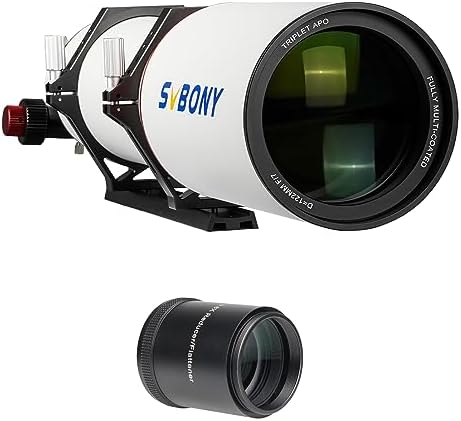
The SVBONY SV550 122mm Kit is a powerful imaging tool featuring a large 122mm aperture for excellent light grasp. With a 4.8 star rating, it is suited for deep sky photography and observing fainter objects that smaller scopes cannot capture clearly.
We may earn a commission when you buy through this link, at no additional cost to you.
Its FPL-51 triplet apochromatic lens structure reduces chromatic aberration and enhances sharpness significantly. The kit includes a focal reducer field flattener to improve imaging quality at the edge of the field, ensuring wide field shots remain crisp and detailed.
The telescope weighs about 6.44kg so it is heavier than compact options. This requires a more robust mount to balance the weight, which adds to the overall cost. However, the gain in image resolution is worth the extra bulk for serious astrophotographers.
This is a great choice for those who want to explore faint nebulae and galaxies. If you are ready to upgrade from smaller apertures and have a stable mount, this kit offers premium optical quality and accessories for top tier imaging performance.
The triplet lens design corrects aberrations better than standard refractors delivering clarity and sharpness across the field.
Includes the necessary focal reducer and field flattener to correct field curvature for wide format sensor compatibility.
We may earn a commission when you buy through this link, at no additional cost to you.
This bundle version of the SVBONY SV550 AP0 brings exceptional value by combining the high quality OTA with essential accessories. It maintains a 4.5 star rating and continues to use the triplet apochromatic optics structure for precise blue-edge correction.
We may earn a commission when you buy through this link, at no additional cost to you.
The air-spaced triple optical design eliminates chromatic aberration while the multiple light barriers inside the barrel improve extinction for higher contrast images. This ensures that bright stars do not cause glare that can ruin deep sky imaging or viewing sessions.
While the bundle saves time on setup, you still need a dedicated mount for stable imaging. It is not a complete system out of the box but the core optical and mechanical components are designed to work together seamlessly for your needs.
Ideal for hobbyists looking to start astrophotography without piecing together parts separately. If you want the best image quality from an 80mm scope and need specific accessories included, this bundle offers a solid balance of quality and cost effectiveness.
Four extinction barriers are designed to meet the ultimate pursuit of reducing stray light for clearer star images.
The design reduces vignetting on full-frame cameras so you can get wide angle views of the night sky effectively.
We may earn a commission when you buy through this link, at no additional cost to you.
The SVBONY SV503 offers a 102mm large diameter aperture that delivers brighter, higher-contrast images for both astrophotography and visual observation. It holds a 4.8 star rating and uses S-FPL51 ED glass to significantly minimize color fringing on bright objects.
We may earn a commission when you buy through this link, at no additional cost to you.
Its FMC coating improves light transmission and reduces internal reflections for sharper details. The built-in 360-degree field rotator allows perfect camera alignment without needing to rotate the entire tube, which is a major convenience for complex imaging setups.
One consideration is the dual-speed focuser and 90mm focus travel, which can be limited if you add thick filter wheels. However, for standard camera setups, it provides precise focusing and maintains critical focus effortlessly during long exposure captures at night.
This is a versatile choice for adults looking for a high-power scope. If you want to observe planets or capture deep sky targets with good detail, this model provides excellent optical performance and convenient features at a competitive price point.
FMC coating and ED glass work together to deliver true-to-life color and sharp detail for visual and imaging use.
The aluminum retractable hood blocks stray light and protects the objective lens while preventing dew formation effectively.
We may earn a commission when you buy through this link, at no additional cost to you.
This premium bundle from SVBONY provides a complete system ready for deep sky imaging immediately. It features the 122mm aperture refractor paired with a guide scope and camera, making it a top choice for astrophotographers who want an integrated solution.
We may earn a commission when you buy through this link, at no additional cost to you.
The camera included has a 1.23-megapixel sensor with small pixels and high peak quantum efficiency for tight tracking of faint guide stars. This setup allows you to autoguide efficiently or even use the main scope for planetary imaging with excellent sensitivity.
The investment is higher due to the bundled accessories and large aperture. Also, the weight of the telescope and accessories requires a very sturdy mount. However, for those who do not want to research separate accessories, this is a ready-to-use professional package.
This kit is perfect for serious hobbyists ready to invest in quality gear. If you want a high-end telescope that can handle faint deep sky objects and includes the critical guiding and imaging hardware, this offers the best value for a complete system.
The included camera supports mainstream auto guiding with low read noise to allow tight tracking of faint guide stars.
The 122mm aperture gathers more light for clearer and detailed images of faint deep sky objects and galaxies.
We may earn a commission when you buy through this link, at no additional cost to you.
The SVBONY SV550 122mm Kit is designed specifically for deep sky astrophotography with a bundle that includes a field flattener. With a 4.8 star rating, this system ensures that stars remain round and sharp across the entire frame for professional quality results.
We may earn a commission when you buy through this link, at no additional cost to you.
The 122mm aperture gathers enough light to capture faint nebulae and galaxies clearly. The included SV209 field flattener corrects field curvature which often plagues refractors when used with larger sensors. This ensures consistent image quality from center to edge.
While it is a high value package, the price is on the higher end. Additionally, the weight of the tube and accessories requires a robust mount to prevent vibration. However, the optical benefits justify the cost for those serious about imaging performance.
This is the ideal choice for observers focused on capturing detailed deep sky images. If you need a telescope that is ready to shoot with a full-frame camera and includes the necessary optics for field flattening, this kit is a top recommendation.
The SV209 field flattener corrects field curvature to improve imaging quality at the edge of the field of view.
The large target surface supports half-frame cameras as well as full-frame cameras for versatile deep sky imaging.
We may earn a commission when you buy through this link, at no additional cost to you.
The SVBONY SV550 80 Triplet APO Telescope Kit offers a complete solution for visual and imaging work. It includes a field flattener to improve image quality at the fringe field, ensuring sharp stars across your entire sensor area for accurate deep sky data.
We may earn a commission when you buy through this link, at no additional cost to you.
Its triplet apochromatic optics structure improves blue-edge chromatic aberration and provides bright, clear images. The wide band fully multilayer coated lens prevents irritating reflections that can degrade contrast in dark sky imaging sessions or high magnification viewing.
While it is compact, you will need to add your own mount and accessories for full operation. The kit is great for reducing setup complexity but does not include a mount. This makes it lighter but requires planning for the support hardware separately.
This kit is a solid option for travel stargazing and photography. If you want a lightweight scope with the necessary flattening optics included to keep your setup simple, this bundle provides the right balance of optical quality and convenience for field use.
Double glass and 30mm achromatic optics prevent reflections to bring you bright and clear images easily.
The carrying handle is designed to improve the safety factor of the product installation process for transport.
We may earn a commission when you buy through this link, at no additional cost to you.
This SVBONY SV550 122mm Kit provides a beginner-friendly approach with a bundle that includes a dovetail base and carrying handle. With a 4.8 star rating, it simplifies the setup process by offering the essential components needed to secure the telescope properly.
We may earn a commission when you buy through this link, at no additional cost to you.
The large 122mm aperture gathers significant light for clear detailed images of faint deep sky objects. The portable handle makes carrying easier, and the dovetail base ensures stability. The SV211 finder scope mount bracket allows for easy installation of guiding accessories to track targets.
While the weight is manageable, the telescope is a significant investment for a beginner. It is heavier than compact options and requires a stable mount to handle the 14.18lb tube weight effectively during long imaging sessions or precise tracking of targets.
This kit is ideal for those starting their deep sky journey who want a robust tool. If you want a large aperture scope that includes the necessary hardware for mounting and carrying, this bundle offers excellent clarity and convenience for learning astrophotography.
The SV211 dovetail base and handle make moving and installing the telescope convenient for easy operation.
The 122mm aperture offers more clear detailed images suitable for deep sky photography and faint objects.
We may earn a commission when you buy through this link, at no additional cost to you.
Selecting the right apochromatic refractor involves understanding key factors that impact optical performance and usability. This guide breaks down the most important specifications to consider before purchasing.
Aperture determines how much light your telescope gathers, which affects the brightness and detail of objects you can see. Larger apertures like 122mm allow you to see fainter deep sky objects, but they also add weight and cost to your system.
For most beginners or travelers, an 80mm to 102mm aperture offers a great balance of performance and portability. If you are serious about deep sky imaging, look for models with at least 102mm aperture to ensure sufficient light grasp.
The focal ratio, expressed as f-number, dictates the speed of your telescope. A lower focal ratio like f/6 is faster, allowing for shorter exposure times in astrophotography. This is ideal for capturing nebulae and galaxies efficiently.
Higher focal ratios like f/7 or f/8 are slower but offer more magnification for planetary imaging. Choose a ratio that matches your primary interest: lower for deep sky wide field, and higher for planetary detail.
Apochromatic refractors use special glass to minimize chromatic aberration. Look for ED (Extra-Low Dispersion) glass like S-FPL51 or FCD1 HOYA, which corrects color fringing better than standard glass. This is crucial for crisp star images.
Triplets typically offer better correction than doublets. Ensure the product description explicitly mentions ED glass and a triplet design to guarantee the color correction you expect from an apochromatic refractor.
Portability is key if you plan to transport your telescope to dark sky sites. Weigh the tube and consider if it fits in your vehicle. Lighter scopes reduce the load on your mount and make setup faster.
Look for features like magnesium alloy parts which reduce weight without sacrificing durability. If you plan to use a portable mount, keep the total payload weight in mind to ensure stability during tracking.
A good focuser ensures you can achieve critical focus for sharp images. Dual-speed focusers with a 1:10 gear reduction allow for precise adjustments. This is essential for fine-tuning focus during astrophotography sessions.
Also check the focuser diameter; 2.5-inch focusers are more robust and compatible with larger accessories. High-quality focusers often include locking screws or other features that maintain focus during long exposures.
Many apochromatic refractors have a curved focal plane which can cause stars to appear elongated at the edges of the frame. A field flattener corrects this, ensuring round stars across the entire image.
Check if the telescope comes bundled with a flattener or if you need to buy one separately. Some models are designed as self-flattened systems, which simplifies your setup and saves money on additional accessories.
A sturdy tube design protects the optics from misalignment and temperature changes. Look for telescopes with retractable dew shields to prevent dew from forming on the lens during cooling.
High-quality paint and internal coatings reduce stray light and improve contrast. Aluminum or steel tubes with machined details indicate a well-built product that will last for years of use.
Customer support and warranty terms are vital for protecting your investment. Check if the manufacturer offers US-based support or reliable service in your region. This ensures you can get help if issues arise.
A good warranty covers manufacturing defects and optical alignment. Ensure you read the terms to understand what is covered and how long the protection lasts for your new telescope.
Always allow your telescope to acclimate to outdoor temperatures before use. Moving the scope from a warm room to a cold night can cause internal air currents that blur images. Leave it outside for about an hour to stabilize the optical elements.
Use dew shields to prevent moisture from forming on the objective lens. If dew does form, use a dew heater or heater pad to clear it gently. Never wipe the optics with cloth as it can scratch the coatings.
Store your telescope in a dry place when not in use. Cover the objective lens with a cap to prevent dust accumulation. Regularly check the mount and tripod for tightness to ensure safe and stable operation.
Apochromatic refractors use special ED glass and multi-element designs to correct chromatic aberration. Unlike standard refractors that show purple halos around bright stars, APOs deliver sharp, color-free images. This makes them ideal for high-contrast imaging and precise planetary observations.
Yes, all the models listed are optical tubes that require a separate mount for stability. You can use a motorized equatorial or altazimuth mount to track celestial objects. Without a mount, the images will appear shaky and unusable for long exposures or precise viewing.
Yes, smaller models like the 80mm apertures are excellent for beginners. They are lightweight and easy to set up. However, you may need to purchase a mount and camera adapter separately. Start with a visual eyepiece before moving to astrophotography to build skills.
For deep sky imaging, a focal ratio between f/6 and f/7 is ideal. These speeds allow for shorter exposure times while maintaining good magnification. Faster scopes are better for wide field nebulae, while slower scopes are better for small planetary details.
Cleaning optics requires care to avoid damage. Use a blower brush to remove dust first. If you must clean, use a lens cleaning solution and a microfiber cloth designed for optics. Avoid touching the glass with your fingers to prevent oils from leaving marks.
Yes, these telescopes can be used for terrestrial viewing such as bird watching or nature observation. However, the images will be inverted. For terrestrial use, you may want a specific erecting eyepiece to correct the image orientation.
We have reviewed ten top apochromatic refractors ranging from compact 80mm options to powerful 122mm kits. The SVBONY SV550 AP0 and Askar 71F stand out as excellent choices for visual and imaging versatility.
When choosing, prioritize aperture size and glass type based on your specific goals. If you are new to astronomy, start with a smaller scope before investing in larger setups. Always consider the total cost of accessories like mounts and cameras.
Remember that prices and availability can change frequently. Check current listings and read user reviews before making your final decision. With the right apochromatic refractor, you will be able to capture stunning views of the night sky.